Abstract
Hydrogen is being increasingly adapted as a decarbonized energy carrier that can reduce global emission [1]. Using the existing natural gas infrastructure for hydrogen transportation and storage is widely considered in various governmental hydrogen initiatives due to its cost efficiency. However, steels which are used in the majority of gas transmission networks are known to be susceptible to hydrogen embrittlement. This problem is drawing significant attention because catastrophic consequences can take place even with a small cracking of pipelines considering hydrogen is explosive in air.
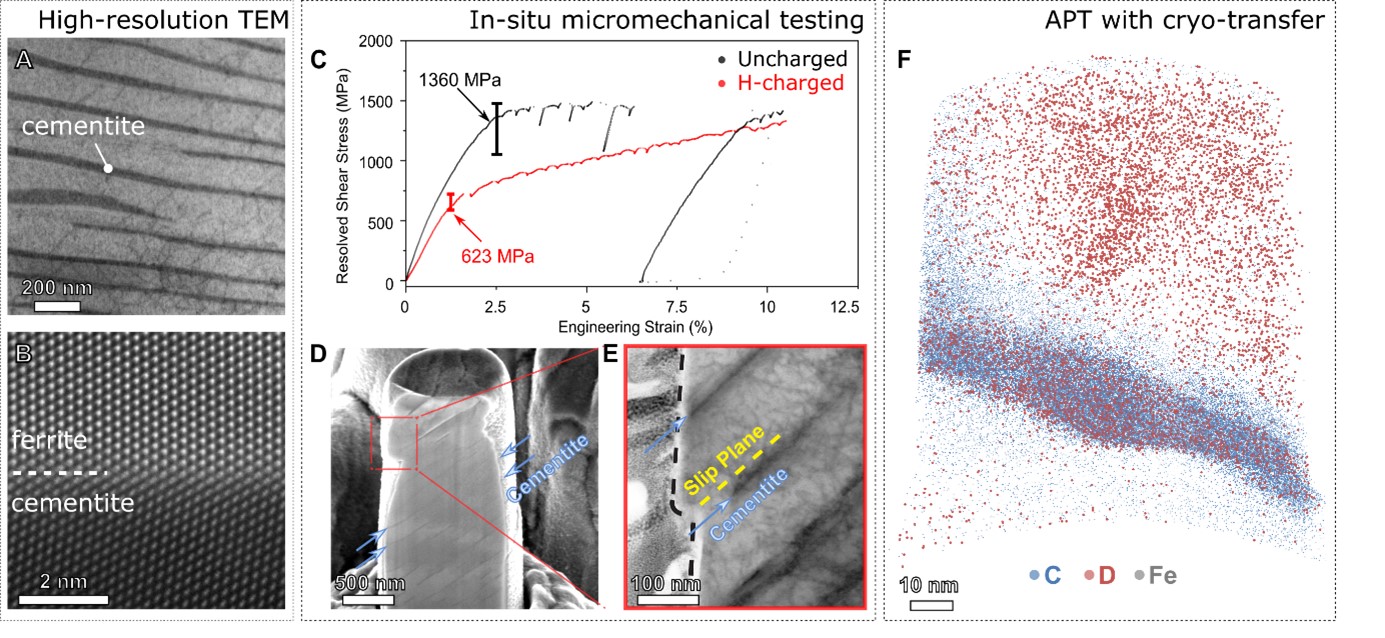
Pearlite is one of the most common microstructures in pipeline steels, consisting with lamellar cementite and ferrite (Fig. A). The interface between the two phases (Fig. B) has been believed to be a primary hydrogen trap [2], but direct evidence of this hypothesis has not been available yet. Here we used in-situ micromechanical electron microscopy in combination with atom probe tomography (APT) to characterise the mechanical effects and the trapping of hydrogen at ferrite–cementite interface. In-situ micromechanical testing shows hydrogen weakens the pearlitic pillars (Fig. C), showing slip deformation at the vicinity of the interfaces (Fig. D & E). APT analysis was conducted by utilising deuterium charging, to circumvent the hydrogen ambiguity from APT vacuum chamber, in combination with cryogenic sample transfer to reduce the diffusion loss of charged deuterium [1, 2]. The result in Fig. F suggests that the deuterium atoms are trapped in cementite bulk, not at the interface. This result could be due to the presence of carbon vacancies in the cementite and the elastic strain around the semi-coherent phase boundary. This result also suggests the hydrogen-induced failure of pearlite should have little relation with the interfacial decohesion due to the absence of hydrogen segregation at interface. This work provides new insights of how hydrogen behaves in pearlite as well as in other steels containing similar type of semi-coherent interfaces.