Abstract
The presence of hydrogen in steels can lead to catastrophic embrittlement/early-fracture. This is a serious issue for hydrogen transportation and storage. However, consensus has not been reached on the exact mechanism of hydrogen embrittlement, mainly due to the difficulty to provide direct evidence of the hydrogen-materials interactions that underpins the hypotheses [1]. In addition, a proposed solution to hydrogen embrittlement by using steels that contain hydrogen traps such as carbide precipitates [2], is limited in its effectiveness, due to the inability to directly observe the proposed hydrogen trapping at microstructural features.
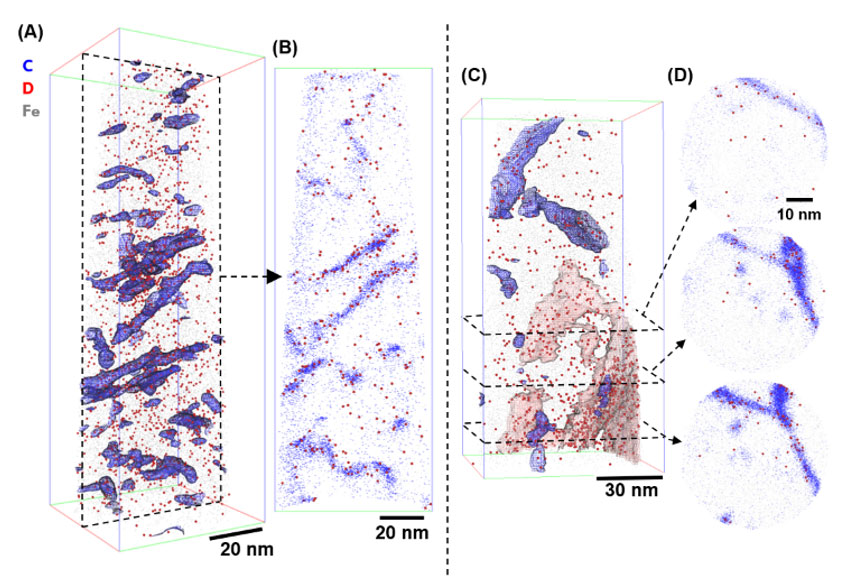
As such, we used atom probe to study the hydrogen distribution at key features, including dislocations [4], grain boundaries [4], and both incoherent [4] and coherent [3] carbide precipitates in BCC/BCT iron matrix. To enable these studies, we charged the sample with deuterium (a hydrogen isotope) to avoid ambiguity from background hydrogen, and utilised a custom cryogenic sample transfer protocol to allow sufficient signal to be retained for observations. These efforts lead to the confirmations of: i) hydrogen enrichment at dislocations (Figure A and B), providing a concrete validation of the hydrogen-enhanced dislocation mobility theory of embrittlement; ii) hydrogen enrichment at grain boundaries (Figure C and D), underpinning the hydrogen-enhanced grain boundary decohesion theory; iii) the hydrogen at the interface between large, incoherent precipitates and the surrounding steel matrix, settling a long-standing debate around whether hydrogen trapping is an interfacial effect; and iv) the hydrogen at the interior of small, coherent carbides, suggesting hydrogen can internalise into carbides under certain conditions.